Full range of motion or partial reps?
Short answer
By default, train through the full range you can control. In a meta-analysis this produced more strength and more leg muscle than partial reps. If you use partials, do them in the stretched range.
Figures
- 16 · studies (Pallarés 2021)
- 0.56 · effect size for strength, full range
- 0.88 · effect size for leg muscle, full range
- 0.88 effect size, positive = favours full range: Leg muscle size
- 0.56 effect size, positive = favours full range: Strength
- 0.44 effect size, positive = favours full range: Physical function (n.s.)
- 0.28 effect size, positive = favours full range: Muscle architecture (n.s.)
What the studies show
Pallarés and colleagues analysed 16 studies. Full range produced more strength (effect size 0.56) and more leg muscle growth (0.88). For muscle thickness and architecture they found no clear difference.
The exception: the stretched range
Not all partials are equal. In Kassiano and colleagues, the medial calf grew by 15.2% with calf raises in the lower, stretched half only, by 6.7% with full range and by 3.4% in the top half only. Short reps at the top, in the shortened range, did worst.
How to use it
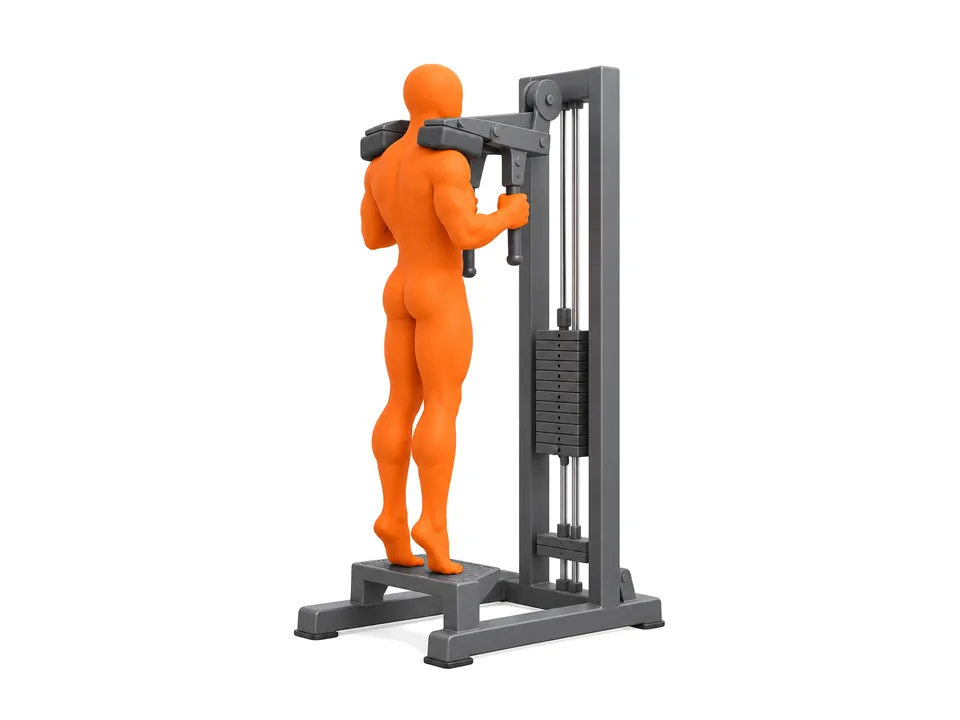
Use the full range you can manage pain-free with clean technique. On calf raises, drop the heel low. If you want partial reps, do them in the stretched range, for example at the end of a set; this is a practical rule.
Sources
- Effects of Range of Motion on Resistance Training Adaptations: A Systematic Review and Meta-Analysis · Pallares; Jesus G; Hernandez-Belmonte; Alejandro; Martinez-Cava; Alejandro; Vetrovsky; Tomas; Steffl; Michal; Courel-Ibanez; Javier · 2021 · Scandinavian Journal of Medicine & Science in Sports PubMed DOI
- Greater Gastrocnemius Muscle Hypertrophy After Partial Range of Motion Training Performed at Long Muscle Lengths. · Kassiano · 2023 · Journal of Strength and Conditioning Research PubMed DOI Study note
- Partial Range of Motion Training Elicits Favorable Improvements in Muscular Adaptations When Carried out at Long Muscle Lengths · Pedrosa; Gustavo F; Lima; Fernando V; Schoenfeld; Brad J; Lacerda; Lucas T; Simoes; Marina G; Pereira; Mariano R; Diniz; Rodrigo C.R; Chagas; Mauro H · 2022 · European Journal of Sport Science PubMed DOI
Summaries by SetCtl, not medical advice.